Thursday, 16 March 2017

Ancient Beast updated and the Deceiver

Ancient Beast 0.3 is here (blog post, forum announcement)! This gorgeously drawn game makes another step towards the vision of its developers.

Heya! It’s been too long since the last release, about 3 years; long time indeed.
We’ve finally repaired the prototype and added several new playable creatures, along with more features,
goodies and bug fixes, not to mention that all the old units have been pretty much revamped.
A ton of work, but it was totally worth it!

Ancient Beast is a player vs player turn based strategy game played online where you command all manner of creatures (3D printed! Beware the power of playing God!) in a battle for supremacy amongst the ruins of the apocolypse. Or something like that. Sounds fun. :)

Ancient Beast 0.3

Deceiver (formerly "The Yearning") has been rebranded in its latest update. GPL licensed code is available on github, and there's a steady history of updates going back 2 years, but the assets remain copyright of the developer.

So is it Free Software? Purists would justifiably say no. For example, no OS (Linux, BSD etc) distribution could include it without the developer's express consent. I can see the reasons for going down this path as the developer is now approaching publishers, and having anybody able to take his game and publish it externally would be an issue of contention. Which brings us back to an old topic of discussion - is it possible to monetize a Free Software game project without compromising on the licensing of any part of it?

Deceiver rain experiments
Some would say such a game shouldn't even appear on this blog, but given the relative inactivity of the blog you'll have to indulge me this once for discussion purposes if nothing else!

Sunday, 12 March 2017

Survey: favourite Red team / Pentest / Attacker methods & tools

SURVEY CLOSED AND RESULTS PUBLISHED:
Popular attacker tools & techniques: survey results


Yesterday I've set up a SurveyMonkey poll in regards to one's favourite Red team / Pentest / Attacker methods & tools.

Purpose of this survey is to get a better insight into which TTPs actual attackers usually use, or at least to get an insight in the most common methods leveraged by red teamers.

Unfortunately, the free version of SurveyMonkey allows only up to 10 questions. Answers are completely anonymous. The survey will run for 7 days, or until 100 responses are received, after which I'll publish a new blog post with the results and some comments.

You can find the survey below, please feel free to complete it and to share:
https://www.surveymonkey.co.uk/r/VSKJJ98

Friday, 10 March 2017

The Izila (& Wenja) Script

Smarkaka salwa! Mashi graybati Winjas : we finally have a writing system for Wenja. This was a system first proposed (in part) during the mocap shoots in Toronto during Summer 2015, though was ultimately not adopted by the creative team at Ubisoft. Here is a snapshot of what that system originally looked like:


Affixed to the back of my script binder, this is perhaps my favorite line in all of the game. It says "Puros putlom suxnus hasosyo."  Here's what that looks like today:


Some definite similarities, but you can see that a number of changes have been made.

Okay, so how does the script work? First & foremost, the Izila script is an alphabet, with characters that represent both vowels and consonants. The original idea was that the Izila invented a writing system to communicate with their celestial gods: Mensi & Suxli. Tensay learned the writing system while he was a slave of the Izila and brought it back to the Wenja village. (NOTE: THIS IS NOT CANON)

Each letter has a name in Izila: < p > is pód, < b > is bárs, etc. Each letter is based off of the first sound of the picture it represents. So, the picture of a foot stands for the letter < p >, because pód, the word for "foot" in Izila begins with a "p". This is a process called acrophony and is actually how our alphabet originally came into being (see here).


The letters themselves are arranged as only a linguist would -- stop consonants are first, moving from the front of the mouth to the back, then fricatives, then nasals, liquids, glides, and finally vowels. There are two letters with dual functions. The letter ulóm "owl" represents both < w > and < u >, and the letter yugí "eternal life" stands for both < y > and < i >. You can see this in two of the examples below. yugí represents < y > in Sayla, but < i > in pati. Similarly, ulóm represents both < w > and < u > in the name Wuga.

When a writing system is first invented (as occurred in the ancient Near East, China, or Mesoamerica), it starts off with letters that do not just represent sounds, but also letters that represent words (i.e., morphemes). Such characters are called logograms.  There are a handful of these in the Izila script.

What this means is that you would never write out the words "Izila", "Wenja", "Udam", etc. using the phonograms listed above. Rather. you would use one of these special signs. 

In addition, there are also additional logograms that can function as determiners, signs that you place before a specific concept to indicate what type of entity that thing is. If the noun in question is an animal, a man, a woman, a god, a spirit, or a tribe, you'll place one of these determiners before it. You can use these symbols as logograms as well.


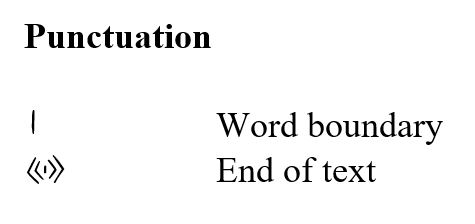
Finally, there are two types of punctuation in the kraybati -- a word-boundary marker and a final symbol that indicates the end of a text.


Allow me to explain logograms, determiners, and punctuation markers with the sentence below. 


Let's first transcribe the writing systems directly into what it says. I've used colons to indicate word boundaries, #  the end of text marker, capitalized all logograms, and superscripted any determiners.

smarkaka:mw:MANWENJApaty:hay:nawa:kraybaty:TRIBEWENJAs#

Let's begin with the word "Winjapati", the third word in the line. It begins with a determiner hnér, which marks that the person in question is a man. Essentially, it's like an unspoken "Mr.". If I were a woman, I'd use the sign gwéni. The determiner hnér is then followed by the logogram WENJA and then the phonograms < p > < a > < t > < y >, resulting in Winjapati. Later in the line the logogram WENJA reappears, but this time it's preceded by génhos, indicating that this Wenja is referring to the tribe (or language). 

As with much of what we have done in Far Cry Primal, this writing system is based in a certain amount of reality. There are a set of symbols called the Vinča Script (Vinča = Winja.... it's too perfect.), which were first used roughly 10,000 years ago. Though many call it a "script", it's unclear if it was actually one. (Highly unlikely that it was).  The symbols used above are taken from the Gimbutas font, designed by Prof. Sorin Paliga, a linguist at the University of Bucharest, Romania. Visit here for a fuller discussion, with references, of the Vinca script and a link to the truetype font so you can make your own Wenja texts.

I'll conclude this post with a sample of some of my favorite lines from the game, written in the Izila script.


Tuesday, 7 March 2017

Trainer Ultimate Marvel vs Capcom 3


------------------------DONLOAD
--------------------------DONLOAD

 -------------------------DONLOAD------------------------DONLOAD

The difference between Themes and Templates in Blogger

This article explains the difference between themes and templates in Blogger, Google's blogging tool.


What is (was) a Blogger template

How a blog that is made with Blogger is shown to a visitor is controlled by four sets of information:
  • The posts which the blogger writes (ie the content)
  • A user-editable "configuration file" which records the overall formatting options which the file designer and then the blogger have chosen
  • Another configuration file, called the post-template, which records choices that the blogger has made under Layout > Blog posts (edit), but cannot be edited elsewhere.   
  • Blogger's own software, which puts the other things together with some internal rules to make "web pages".   Bloggers cannot control the rules in this at all.

Originally, the first "configuration file" was called a template.   In fact, officially it was called a design-template, to distinguish it from the post-template.   However because most people aren't aware of the post template, usually just the word "template" is used to mean design-template.


What is a theme

Other blogging tools (eg Wordpress, Tumblr) called their equivalent file a theme.    Most (or even all) of those tools provide less access to change things in the Theme file, for example if you use a Wordpress free-hosted blog, then you cannot change any of the code in your theme, you can only make formatting changes which are allowed for in the Wordpress front-end.

Many of the Wordpress themes have had a lot of  graphic design work done on them - using them gives a blog-site which looks very attractive (or otherwise suited for their purpose) on a wide range of screens.    Many large websites have been made using Wordpress, and so very many professional designers have created Wordpress themes.    Because of this, many people believe that it's easier to get an excellent-looking website from a theme than from a Blogger template.

Blogger templates have now become themes

Recently - I noticed it in March 2017 - Blogger started calling their templates "themes".  
  • They've changed the menu option on their dashboard from "Template" to "Theme".
  • They've changed the action button names in the template/theme editor to say things like "Save theme".
  • They've written various help articles which refer to themes.


What hasn't changed

  • We can still edit our templates themes extensively.
  • The Blogger tools that make the changes in our themes haven't changed:  All the items under the Themes tab on the dashboard are the same as the ones on the Templates tab.
  • The contents of our existing themes are still much the same  (I cannot guarantees they haven't made any changes, but I haven't seen any)
  • The themes that we can choose from when making a new blog, or changing the format of an existing one, are the same.
  • There are hundreds of help and how-to articles written by blogger-helpers like myself, which all refer to templates.   (I've started changing mine - but it's going to take a while!)

What else is going to change?   

This is the big question:   Is the rename a precursor to some other changes, eg restricting how much control we have over our themes? - or is it just a cosmetic change to make Blogger seem more modern?

Will there be some new themes released - ones that look better across a range of devices, maybe even some that are optimized for mobile instead of desktop use?

Will there be new theme-editing features introduced into Blogger's interface, to let us control things we cannot control now?

Conclusion / TL-DR

Only Google's Blogger product managers know exactly what the future plans for Blogger are - and they're not known for talking about the future direction  until they're just about to introduce new features.   

But until they do, my conclusion is that there is no difference between templates and themes in Blogger.  They are simply two different words for exactly the same thing.


NB:   Blogger product a announcements are usually made in the Blogger Buzz blog - and I see that template were still called templates in their most recent post in November 2016:


Related Articles

How to edit your Theme in Blogger

What types of theme / templates does Blogger have

Editing your blog's template:  advantages and disadvantages

How to turn on a mobile theme for your blog

Blogs, Blogger, bloggers, posts pages and screens - understanding Blogger-basics

How to make a real website, using Blogger