Tuesday, 21 July 2015

Extreme Car Driving Simulator v4.05.2 MOD

Extreme,Extreme download,Extreme Game Free Download,Car Driving,Car Driving Game,Car Driving Game Free Download,Car Driving Game Android Download,Car Driving Download,Car Driving Simulator,Car Driving Simulator Game Free Download,Car Driving Simulator Game Download,Car Driving Simulator Android Download,Car Driving Simulator 2015 Game Free Download,Car Driving Mod Download,Car Driving Game Mod Android Download,Car Driving Free Download Mod,Car Driving Mod,Extreme Car Driving Simulator v4.05.2 MOD,Extreme Car Driving Simulator v4.05.2 MOD Free Download,Extreme Car Driving Simulator v4.05.2 MOD Game Free Download,
Extreme Car Driving Simulator v4.05.2 MOD
Extreme driving simulator
A simulation style game (simulator) can be seen as a style Salyst. Most of these games such cars, boats, planes, helicopters and cars as germination, the destruction is not only fun, but it is also considered a training topic. This credo has led to sports simulation and realistic nature of the game is on. Challenging.Turbo GT racing games more realistic and extreme racing simulator game series now in Spain, in one of the most popular products will inspire more difficult.
Extreme,Extreme download,Extreme Game Free Download,Car Driving,Car Driving Game,Car Driving Game Free Download,Car Driving Game Android Download,Car Driving Download,Car Driving Simulator,Car Driving Simulator Game Free Download,Car Driving Simulator Game Download,Car Driving Simulator Android Download,Car Driving Simulator 2015 Game Free Download,Car Driving Mod Download,Car Driving Game Mod Android Download,Car Driving Free Download Mod,Car Driving Mod,Extreme Car Driving Simulator v4.05.2 MOD,Extreme Car Driving Simulator v4.05.2 MOD Free Download,Extreme Car Driving Simulator v4.05.2 MOD Game Free Download,
Features

    
The graphics are very good,
    
Great gameplay, easy and very fun
    
Low volume without data
    
Methods and realistic physical game
    
Excellent
    
Free mode, traffic mode, check mode Use 3 different types of games
    
Setting the controller 3 game modes
    
Showing speed, gear position and ...
    
Different positions adjustable camera
    
And the ability to earn points to buy more cars
    
In the event of a collision with other objects real damage to the vehicle body
    
Simulation ABC, TC, ESP
    
Button for manually pulling the hand breaking exist
    
There are sports cars and famous
How to install?

    
Download from the link below APK.
    
Move to SD card and install as normal,
    
You're done! Enjoy !! :)

Screenshots
Extreme,Extreme download,Extreme Game Free Download,Car Driving,Car Driving Game,Car Driving Game Free Download,Car Driving Game Android Download,Car Driving Download,Car Driving Simulator,Car Driving Simulator Game Free Download,Car Driving Simulator Game Download,Car Driving Simulator Android Download,Car Driving Simulator 2015 Game Free Download,Car Driving Mod Download,Car Driving Game Mod Android Download,Car Driving Free Download Mod,Car Driving Mod,Extreme Car Driving Simulator v4.05.2 MOD,Extreme Car Driving Simulator v4.05.2 MOD Free Download,Extreme Car Driving Simulator v4.05.2 MOD Game Free Download,
Extreme Car Driving Simulator v4.05.2 MOD

Extreme,Extreme download,Extreme Game Free Download,Car Driving,Car Driving Game,Car Driving Game Free Download,Car Driving Game Android Download,Car Driving Download,Car Driving Simulator,Car Driving Simulator Game Free Download,Car Driving Simulator Game Download,Car Driving Simulator Android Download,Car Driving Simulator 2015 Game Free Download,Car Driving Mod Download,Car Driving Game Mod Android Download,Car Driving Free Download Mod,Car Driving Mod,Extreme Car Driving Simulator v4.05.2 MOD,Extreme Car Driving Simulator v4.05.2 MOD Free Download,Extreme Car Driving Simulator v4.05.2 MOD Game Free Download,
Extreme Car Driving Simulator v4.05.2 MOD
Download Links
Extreme Car Driving Simulator Mod Apk | Mirror  (40 MB)

Monday, 20 July 2015

How to find the URL for a picture in Google Photos

This article describes how to get the URL or internet address of a picture in Google Photos, and the difference between Google's shareable links and URLs.


Google Photos is a tool that help bloggers (and everyone else) to manage their picture collections. It replaces Google+ Photos, and works alongside Picasa-web-albums.   You can read more about it here.

In Google Photos, there are two different types of web-address for a photo.
  • One is the URL, and this can be used to refer to pictures from Blogger, or from other tools that want a link that just shows the photo, eg Twitter, Google Maps.  This is the traditional style of internet-address for a photo.
  • The other is the shareable link.   This is what Google Photos provides from the Share function.   Shareable links can be used in Facebook, and other places where the photo that is being shared is displayed within a web-display, rather than just as a picture.   (Ref:  How to make and manage shareable links in Google Photos.)

Unfortunately shareable links cannot be used in many applications.  This is because they don't just show the picture.   Instead they load a display showing the picture-date, the name and picture of the person who is logged in to Google at the time, and any other pictures that you have included in the same shareable link.

If you want to use an image from Google Photos in a tool which cannot use shareable links, you need to find it's URL, instead.   At the moment, Google Photos doesn't have a way to get this - but luckily it's easy enough to find.


How to get the URL or web-address of a photo in Google Photos, using your computer

Log in to Google Photos

Navigate to the picture that you want to get the link for.  

Click on the picture, so you see it in full screen mode.


Right click on the body of the photo and choose the "copy link" command from the menu that pops up where you clicked.  

The exact wording of this command varies between browsers on operating system.   For example in Chrome / Windows 8, it is simply "Copy Image URL"


In Internet Explorer 11 / Windows 8, you need to choose Properties from the pop-up menu, and then copy the value from the URL-field in the window that opens


Job done! The URL for the photo which you were looking at is now in your computer's memory, and you can paste it (with ctrl/v or Edit > Paste) into any other place that wants it - for example Blogger's photo-insert wizard, or an email message or discussion forum or chat window.


The URL from your address bar doesn't work

You may be tempted to just copy and paste the URL from the address-bar in your browser. And this will work for you.

But if someone else (or you, when you are not logged in to the same Google account) tries to use it, they will get either:
  • A 404 error (if you are logged in to a different Google account), or
  • Invited to log in to your Google account - followed by a 404 error if the Google account you log in to is not the one that owns the picture.


How to get the URL or web-address of a photo in Google Photos, using your phone (Android or iOS)

Unfortunately I have not managed to find a way to get photogrpah URL (rather than the shareable link) from my smartphone as yet.

If you can suggest any ways to do this, please leave a comment below.


Where to find more information

Introducing Google Photos:  how does it compare to Google Plus Photos and Picasa-web-albums

How to change the date of a picture in Google Photos

How to get the shareable link for one or more pictures in Google Photos

Putting pictures and text side-by-side in blog-posts

Sunday, 19 July 2015

Android MySQL Database Operations

In this post we are going to learn about how to connect to MySQL Database from your Android Application and perform database operations. Here we create an android app that contain some login Activity through which the user can retrieve information from database and a registration Activity through which the user can add information into the database. 

First you need to have the following components installed in your development machine. 
1. Database : Here we use the MySQL database.
2. Web Server : Here we use the Apache Web Server.
3. Server side Scripting Language :  Here we use PHP for server side scripting.
4. Android Development environment : You must install android sdk and android studio.  

I recommend you to download and install WAMPSERVER. The wamp server installer contains the following components.
Apache Server Application
MySQL Database
PHP/phpMyAdmin

First we have to create the database and table in MySQL. You can use the phpMyAdmin for mange your MySQL databases. Here our database name is "webappdb" and table name is "user_info".  
The table contains three columns "name", "user_name" and "user_pass". 

For our android application create a new folder inside the public directory of the wamp server and name the folder as "webapp".
First we have to write the needed php scripts and put it in the public directory of the wamp server. Here we need three php scripts, first one is for establish a connection with the database, second one for add informations into database and the last one for retrieve informations.

1. init.php
 <?php  
$db_name = "webappdb";
$mysql_user = "root";
$mysql_pass = "root";
$server_name = "localhost";
$con = mysqli_connect($server_name,$mysql_user,$mysql_pass,$db_name);
?>

2. register.php
 <?php  
require "init.php";
$name = $_POST["user"];
$user_name = $_POST["user_name"];
$user_pass = $_POST["user_pass"];
$sql_query = "insert into user_info values('$name','$user_name','$user_pass');";
?>

3. login.php
 <?php  
require "init.php";
$user_name = $_POST["login_name"];
$user_pass = $_POST["login_pass"];
$sql_query = "select name from user_info where user_name like '$user_name' and user_pass like '$user_pass';";
$result = mysqli_query($con,$sql_query);
if(mysqli_num_rows($result) >0 )
{
$row = mysqli_fetch_assoc($result);
$name =$row["name"];
echo "Login Success..Welcome ".$name;
}
else
{
echo "Login Failed.......Try Again..";
}
?>


Create an android application contain a Login Activity and Register Activity. 

activity_main.xml (Login Activity layout)
 <LinearLayout xmlns:android="http://schemas.android.com/apk/res/android"  
xmlns:tools="http://schemas.android.com/tools" android:layout_width="match_parent"
android:layout_height="match_parent" android:paddingLeft="@dimen/activity_horizontal_margin"
android:paddingRight="@dimen/activity_horizontal_margin"
android:paddingTop="@dimen/activity_vertical_margin"
android:paddingBottom="@dimen/activity_vertical_margin" tools:context=".MainActivity"
android:background="#0BB990"
android:orientation="vertical"
>
<TextView
android:layout_width="wrap_content"
android:layout_height="wrap_content"
android:text="Login Form"
android:textAppearance="?android:textAppearanceLarge"
android:textStyle="bold"
android:layout_gravity="center_horizontal"
android:layout_marginTop="10dp"
/>
<EditText
android:layout_width="250dp"
android:layout_height="wrap_content"
android:hint="User Name"
android:id="@+id/user_name"
android:layout_gravity="center_horizontal"
android:layout_marginTop="70dp"
/>
<EditText
android:layout_width="250dp"
android:layout_height="wrap_content"
android:hint="Password"
android:id="@+id/user_pass"
android:layout_gravity="center_horizontal"
android:layout_marginTop="20dp"
android:inputType="textPassword"
/>
<Button
android:layout_width="100dp"
android:layout_height="wrap_content"
android:text="Login"
android:layout_gravity="center_horizontal"
android:layout_marginTop="10dp"
android:onClick="userLogin"
/>
<Button
android:layout_width="wrap_content"
android:layout_height="wrap_content"
android:text="Register Now"
android:layout_gravity="center_horizontal"
android:layout_marginTop="50dp"
android:onClick="userReg"
/>
</LinearLayout>
android-localhost
register_layout.xml (Register Activity Layout)
 <LinearLayout xmlns:android="http://schemas.android.com/apk/res/android"  
xmlns:tools="http://schemas.android.com/tools" android:layout_width="match_parent"
android:layout_height="match_parent" android:paddingLeft="@dimen/activity_horizontal_margin"
android:paddingRight="@dimen/activity_horizontal_margin"
android:paddingTop="@dimen/activity_vertical_margin"
android:paddingBottom="@dimen/activity_vertical_margin"
tools:context="com.easyway2in.mysqlconnect.Register"
android:orientation="vertical"
android:background="#0BB990"
>
<TextView
android:layout_width="wrap_content"
android:layout_height="wrap_content"
android:text="Registration Form"
android:textAppearance="?android:textAppearanceLarge"
android:textStyle="bold"
android:layout_gravity="center_horizontal"
android:layout_marginTop="10dp"
/>
<EditText
android:layout_width="250dp"
android:layout_height="wrap_content"
android:hint="Name"
android:id="@+id/name"
android:layout_gravity="center_horizontal"
android:layout_marginTop="40dp"
/>
<EditText
android:layout_width="250dp"
android:layout_height="wrap_content"
android:hint="User Name"
android:id="@+id/new_user_name"
android:layout_gravity="center_horizontal"
android:layout_marginTop="20dp"
/>
<EditText
android:layout_width="250dp"
android:layout_height="wrap_content"
android:hint="Password"
android:id="@+id/new_user_pass"
android:layout_gravity="center_horizontal"
android:layout_marginTop="20dp"
android:inputType="textPassword"
/>
<Button
android:layout_width="130dp"
android:layout_height="wrap_content"
android:text="Register"
android:layout_gravity="center_horizontal"
android:layout_marginTop="30dp"
android:onClick="userReg"
/>
</LinearLayout>

android-database-tutorial

In this tutorial we use the HttpUrlConnection instead of HttpClient. HttpClient is deprecated form API level 22.
Ads By Google


Here the server is localhost and we test the application on an android virtual device. We need two URL. First one for registration purpose and the second one is for user Login.

Register URL : ""http://10.0.2.2/webapp/register.php";
Login URL"http://10.0.2.2/webapp/login.php";

Here we use the IP (10.0.2.2) -because the android virtual device use this default IP for connect to the localhost. You can also use your local computer IP address. This application use an AsyncTask to perform the server operations. 

MainActivity.java
 package com.easyway2in.mysqldbdemo;  
import android.app.Activity;
import android.content.Intent;
import android.os.StrictMode;
import android.support.v7.app.ActionBarActivity;
import android.os.Bundle;
import android.view.Menu;
import android.view.MenuItem;
import android.view.View;
import android.widget.EditText;
public class MainActivity extends Activity{
EditText ET_NAME,ET_PASS;
String login_name,login_pass;
@Override
protected void onCreate(Bundle savedInstanceState) {
super.onCreate(savedInstanceState);
setContentView(R.layout.activity_main);
ET_NAME = (EditText)findViewById(R.id.user_name);
ET_PASS = (EditText)findViewById(R.id.user_pass);
}
public void userReg(View view)
{
startActivity(new Intent(this,Register.class));
}
public void userLogin(View view)
{
login_name = ET_NAME.getText().toString();
login_pass = ET_PASS.getText().toString();
String method = "login";
BackgroundTask backgroundTask = new BackgroundTask(this);
backgroundTask.execute(method,login_name,login_pass);
}
}


BackgroundTask.java
 package com.easyway2in.mysqldbdemo;  
import android.app.AlertDialog;
import android.content.Context;
import android.os.AsyncTask;
import android.widget.Toast;
import java.io.BufferedReader;
import java.io.BufferedWriter;
import java.io.IOException;
import java.io.InputStream;
import java.io.InputStreamReader;
import java.io.OutputStream;
import java.io.OutputStreamWriter;
import java.net.HttpURLConnection;
import java.net.MalformedURLException;
import java.net.URL;
import java.net.URLEncoder;
/**
* Created by prabeesh on 7/14/2015.
*/
public class BackgroundTask extends AsyncTask<String,Void,String> {
AlertDialog alertDialog;
Context ctx;
BackgroundTask(Context ctx)
{
this.ctx =ctx;
}
@Override
protected void onPreExecute() {
alertDialog = new AlertDialog.Builder(ctx).create();
alertDialog.setTitle("Login Information....");
}
@Override
protected String doInBackground(String... params) {
String reg_url = "http://10.0.2.2/webapp/register.php";
String login_url = "http://10.0.2.2/webapp/login.php";
String method = params[0];
if (method.equals("register")) {
String name = params[1];
String user_name = params[2];
String user_pass = params[3];
try {
URL url = new URL(reg_url);
HttpURLConnection httpURLConnection = (HttpURLConnection) url.openConnection();
httpURLConnection.setRequestMethod("POST");
httpURLConnection.setDoOutput(true);
//httpURLConnection.setDoInput(true);
OutputStream OS = httpURLConnection.getOutputStream();
BufferedWriter bufferedWriter = new BufferedWriter(new OutputStreamWriter(OS, "UTF-8"));
String data = URLEncoder.encode("user", "UTF-8") + "=" + URLEncoder.encode(name, "UTF-8") + "&" +
URLEncoder.encode("user_name", "UTF-8") + "=" + URLEncoder.encode(user_name, "UTF-8") + "&" +
URLEncoder.encode("user_pass", "UTF-8") + "=" + URLEncoder.encode(user_pass, "UTF-8");
bufferedWriter.write(data);
bufferedWriter.flush();
bufferedWriter.close();
OS.close();
InputStream IS = httpURLConnection.getInputStream();
IS.close();
//httpURLConnection.connect();
httpURLConnection.disconnect();
return "Registration Success...";
} catch (MalformedURLException e) {
e.printStackTrace();
} catch (IOException e) {
e.printStackTrace();
}
}
else if(method.equals("login"))
{
String login_name = params[1];
String login_pass = params[2];
try {
URL url = new URL(login_url);
HttpURLConnection httpURLConnection = (HttpURLConnection)url.openConnection();
httpURLConnection.setRequestMethod("POST");
httpURLConnection.setDoOutput(true);
httpURLConnection.setDoInput(true);
OutputStream outputStream = httpURLConnection.getOutputStream();
BufferedWriter bufferedWriter = new BufferedWriter(new OutputStreamWriter(outputStream,"UTF-8"));
String data = URLEncoder.encode("login_name","UTF-8")+"="+URLEncoder.encode(login_name,"UTF-8")+"&"+
URLEncoder.encode("login_pass","UTF-8")+"="+URLEncoder.encode(login_pass,"UTF-8");
bufferedWriter.write(data);
bufferedWriter.flush();
bufferedWriter.close();
outputStream.close();
InputStream inputStream = httpURLConnection.getInputStream();
BufferedReader bufferedReader = new BufferedReader(new InputStreamReader(inputStream,"iso-8859-1"));
String response = "";
String line = "";
while ((line = bufferedReader.readLine())!=null)
{
response+= line;
}
bufferedReader.close();
inputStream.close();
httpURLConnection.disconnect();
return response;
} catch (MalformedURLException e) {
e.printStackTrace();
} catch (IOException e) {
e.printStackTrace();
}
}
return null;
}
@Override
protected void onProgressUpdate(Void... values) {
super.onProgressUpdate(values);
}
@Override
protected void onPostExecute(String result) {
if(result.equals("Registration Success..."))
{
Toast.makeText(ctx, result, Toast.LENGTH_LONG).show();
}
else
{
alertDialog.setMessage(result);
alertDialog.show();
}
}
}

Add the Internet permission in Manifest file.
 <uses-permission android:name="android.permission.INTERNET"></uses-permission>"  

Watch Video Tutorial Of this Topic

Download This Android Studio Project
   
This is how an android application connect to MySQL database run on a remote server and perform basic database operations. I hope you got the concepts. Please share your experience via comments.


Saturday, 18 July 2015

How to share pictures from Google Photos, using shareable-links

This article describes how to get a link to one ore more photos from your Google Photos collection, using the Shareable Link controls.   It also explains how to delete shareable links that you have made in the past


Google Photos is a tool for managing picture collections. It replaces Google+ Photos, and works alongside Picasa-web-albums.   You can read more about it here.

Shareable Links are a new type of linking introduced in Google Photos, which let you easily share one or more pictures at the same time.   You can email them, or use them in tools like Facebook.

When someone opens a shareable link, they see a display with the date, the name and picture of the person who is logged in to Google at the time, and all the pictures that are included in the same shareable link.

If you want to use an image from Google Photos in a tool which cannot use shareable links, you need to find the URL for the photo, instead.


How to get the shareable link for one photo in Google Photos

Log in to Google Photos

Navigate to the picture that you want to get the link for.  

Click on the picture, so you see it in full screen mode.

Hover your mouse towards the top-right of the screen, and you will see some control show up: these are quite small, and are white (so may be harder to see against some backgrounds).

One of the controls is the Share icon:  it looks like a side-ways triangle with one bar missing.     Click it.


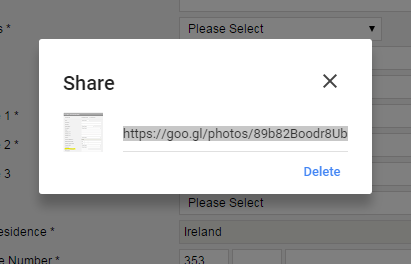
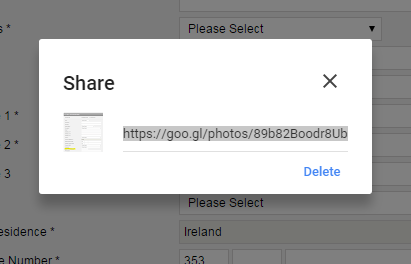
In the Share pop-up that opens, click "Get shareable link"


Wait while Photos generates a link.

When it is finished, copy the link text.  
(Ctrl/c on the keyboard is the easiest way to do this, since the text is automatically selected).


Job done! The display address for the photo which you were looking at is in your computer's memory, and you can paste it (with ctrl/v or Edit > Paste) into any other place that wants it (eg Facebook, in an email message, or something that will accept an address which displays the photo inside a "wrapper" of some sort.  s photo-insert wizard, or an email message or discussion forum or chat window).


How to get the shareable link for more than one picture

You can share several (or lots) of photos with someone by just giving them one web-address, which opens up a screen with all the photos.

 To do this:

Click the small selection icon (tick) at the top left hand side of each picture that you want to include.
(Once a photo is selected, the icon shows as blue, and there is a border around the picture).


Hover your mouse towards the top-right of the screen, and you will see some control show up: these are quite small, and are white (so may be harder to see against some backgrounds).


Click the Share control icon:  it is the one that the arrow is pointing to in the picture just above this.

Continue in the same way as for getting a shareable link to an individual photo (ie the section above)


What does the Delete link do

You may have noticed that there is a delete function on the Shareable link screen.


If you click it, then you are given the chance to delete any existing links to the currently selected group of photos.


This doesn't seem to make any sense at the time when you are first making the link.

But it also works later on:  if you have the same photos selected and choose to get the shareable link again, you will get the same link - and you may delete it instead.

This does not delete the photos themselves, just the previous link to the currently-selected group of photos.   If anyone (or anything, eg Facebook) tries to use that link again, they will get an error message instead.

Another way to delete links is from the left-side menu in Photos:  Choosing  More > Shared links shows you al list of all shareable links you have ever made, and then for each one you can either copy the link or delete it.


Where to find more information

Introduction to Google Photos

How to put a picture into a post in Blogger

Thursday, 16 July 2015

Free AddmefastBot 1k Point+/Hour [Private Bot]


If you want the bot, send me message: rexsniper66@gmail.com

Subject: Request AddmefastBot